




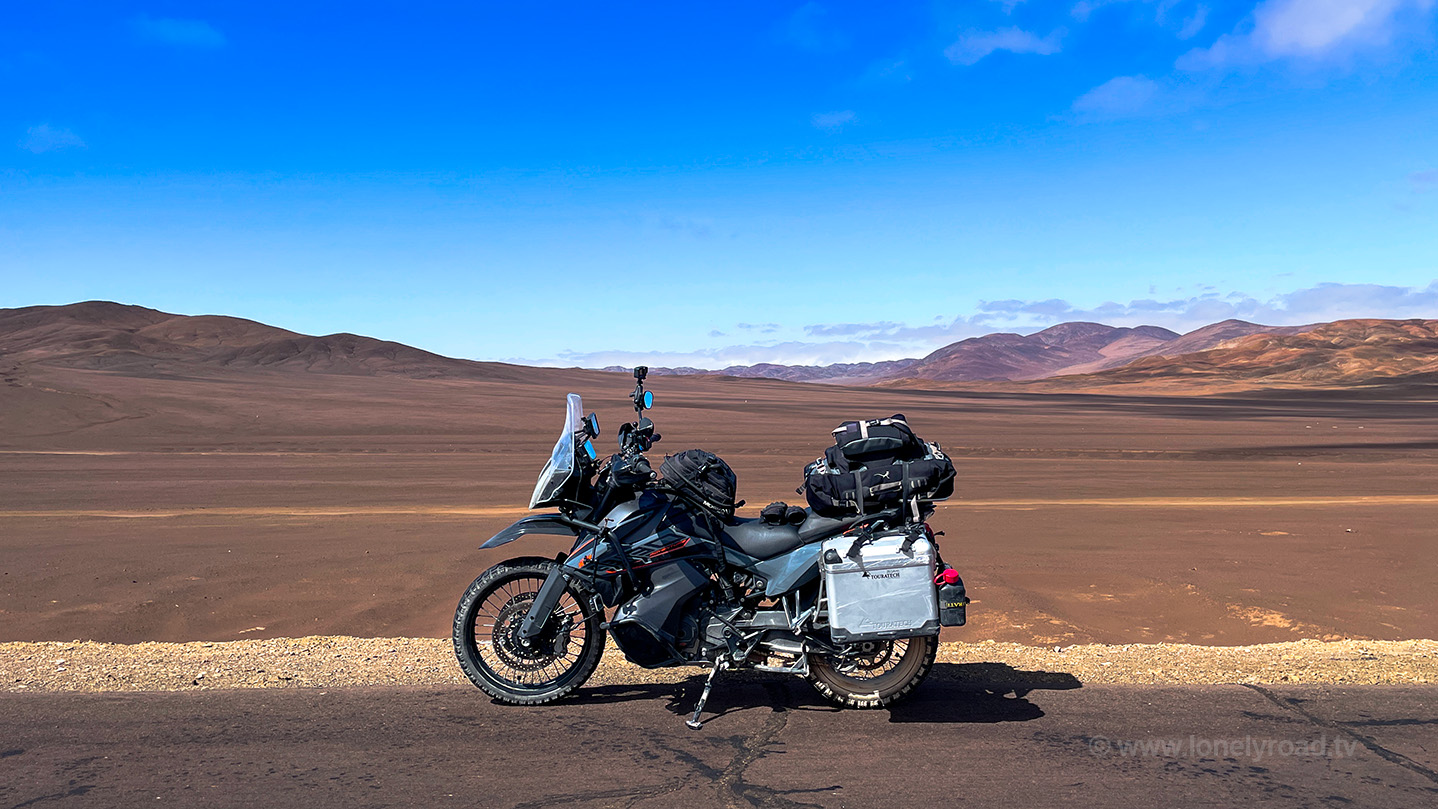
Border Crossing – Algeciras, Spain to Tangier Med, Morocco
Crossing Date: 14 October 2025
Direction: Spain to Morocco
Altitude: 0m
Vehicle: UK-registered motorcycle
People: 1
Total time: 3 hrs (inc. ferry)
Rating: 4/5 (Smooth)
Whilst far from the only crossing from Spain to Morocco, Algeciras - Tangier Med is by far the busiest and probably easiest, particularly for first-timers. Large car ferries whisk you across the Strait of Gibraltar in a snappy 90 minutes and Tangier Med itself is a secure, modern port, equal to anything you’d find in Europe.
Note that Tangier Med is about an hour's drive (circa 47km) northeast of the city of Tangier itself. Ferries do also go directly to the old port in the city, which is referred to as Tangier Ville to avoid confusion.
The Process
There are a range of ferry operators vying for your business and tickets must be purchased ahead of time. The easiest way to do this is online, but you can also do it in person on the day, either in the ticket office at the Algeciras ferry port or at one of several ticket booths you'll encounter as you approach town.
Around the port, there are also plenty of touts offering supposedly great deals, but they are best avoided as you won't save much and some can be scams. On the day tickets can normally be purchased up until about 90 minutes before departure, but may occasionally sell out during peak periods.
After arrival at the port, and assuming you've pre-purchase a ticket, it may still be necessary to visit the ticket office to collect a boarding pass before proceeding to embarkation. Most ferry companies expect you to be at the port at least 90 minutes before scheduled departure if you're travelling with a vehicle.
Embarkation is a simple matter of following the signs for the Tangier Med ferries to the check-in booth, showing your boarding pass, and making your way to the pre-boarding area. The length of wait here will depend, firstly on how busy the sailing is, and secondly, how early you’ve arrived. At some point during the wait, your ticket will be checked again and eventually you'll be allowed to proceed to passport control where you'll exit Spain for immigration purposes.
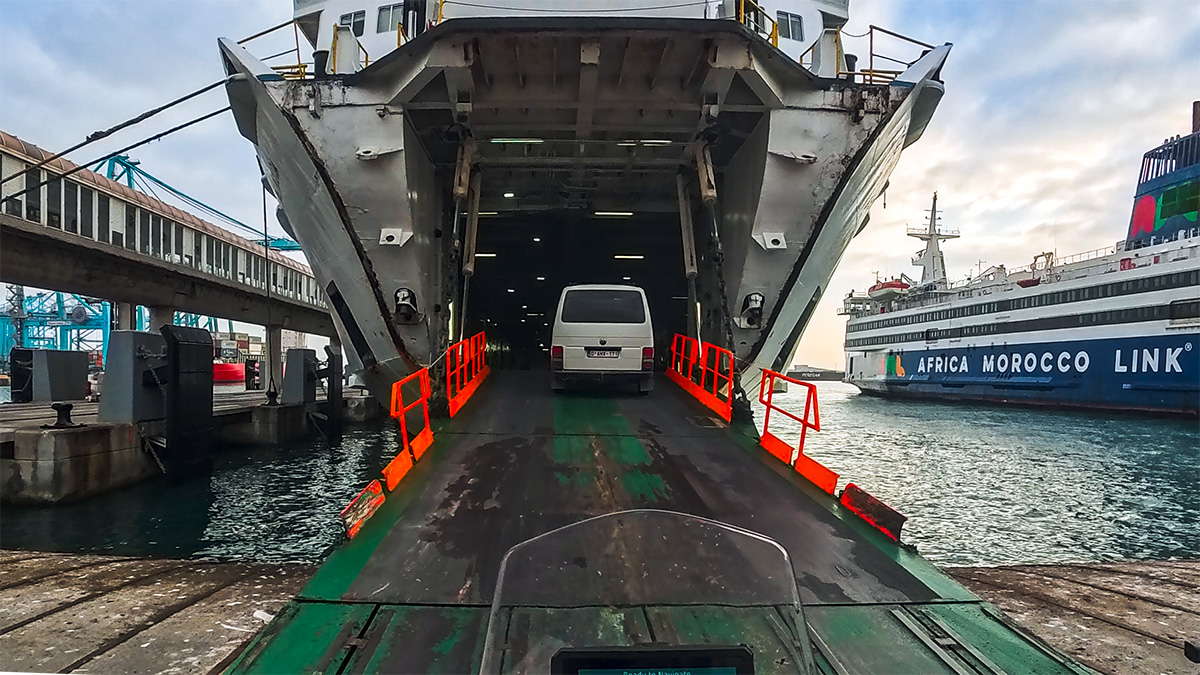
Staff will then direct you to your ferry boarding ramp and show you where to park, depending on your vehicle type. As with many ferry crossings, motorcycles will be secured by the staff using ratchet straps. You'll then need to ascend to the passenger deck as vehicle spaces are off limits during the crossing.
These days, Moroccan immigration formalities are completed on the ferry during the crossing. At some point an announcement will be made and you’ll need to find your way to the Moroccan police window where an official will review your passport and provide the necessary stamps. You'll also need to complete a paper landing card before getting your passport stamped. These will be available at the ferry’s onboard information desk.
On arrival in Tangier Med, you can return to your vehicle and disembark under the staff instructions. Another Moroccan official will be on hand to check your passport stamp after your wheels hit dry land. Assuming all is well, you then follow the signs to the customs (douane in French) area to get a temporary import permit for your vehicle. It's fairly easy to get to, but reasonably far from the boat ramp.
At customs, you simply pull up and wait for instructions from the officials. The basic process involves providing your stamped passport and vehicle documents and letting the wheels of bureaucracy run their course. Eventually, your documents will be returned and you'll be given a small slip of paper which you’ll later need to hand to an officer at the exit gate. At this point, customs will likely want to search your vehicle, but how thoroughly they do so will largely depend on what type of vehicle you're traveling with. Motorcycles are typically only subjected to a cursory luggage inspection. You'll also be asked – likely on several occasions – whether you're carrying a drone. These are illegal in Morocco and will always be confiscated if found. Theoretically, confiscated drones are supposed to be stored at your point of entry and returned to you on departure, but whether that actually happens is another story entirely.
With the customs process complete, you then simply make your way to the exit gate where another officer will check that your documents match the vehicle shown on your small slip of paper. Assuming all is well, you can continue on your way into the still secure public area. Here you’ll find a café, toilets, and various money changer booths, but probably most usefully, an insurance booth.
To drive your own vehicle in Morocco, you need at least minimum third-party insurance. Virtually no standard European policy will cover you in Morocco so it's essential to buy at the port or as soon as possible after you arrive. As a foreigner, if you have an accident driving in Morocco without insurance, you'll very likely end up in jail. Policies are available for 10, 30, and 90 days, with prices varying depending on your vehicle type. It's worth noting that the insurance booth at the port is cash only, with payment accepted in either euro or dirham. As the base price is in euro, it's best to pay in that currency too (although you will get change in dirham where necessary).
With insurance all sorted, you can proceed to the port complex exit. This dumps you right on the main road (N16) which itself becomes the A5 motorway not far down the road. Make sure you get some dirham before entering the motorway, as most of the toll booths only take cash. You can of course do this at any of the money changer booths in the port complex, but their rates won’t be great.
An alternative is to swing by the Al Barid Bank ATM at the Post Office (Poste Maroc) in the small town of Ksar es Seghir, just down the road from the port. Unlike other ATMs across Morocco, all Al Barid Bank machines are free to use - even for foreigners - and you'll find them at most post offices. It’s possible to get to Ksar es Seghir from the A5 motorway before you reach any toll booths – simply take the first exit you come to heading south.
How it Went for Me
As I've travelled with them before and had a good experience, I booked my ferry ticket with Balearia ahead of time. The confirmation email directed me to download their app so I could, amongst other things, get a digital boarding pass. However, the app would not allow this, instead directing me to pick up my boarding pass from a Balearia ticket office. Not the end of the world, as there's one at Algeciras port, but a pain none-the-less.
To be safe, I swung by the ticket office the day before and collected my boarding pass. It took all of two minutes for the guy to simply print it out, no additional checks or information required. Which begs the question why couldn't they just email it to me so I could print it myself, or better, allow the app to fulfil its purpose. But anyway...
The Balearia website unhelpfully suggests that if you’re travelling with a vehicle, you should arrive at least 5 hours (!) before your departure time. I’m not sure if this is a typo on the English version, but you certainly don't need to be there anywhere near that early – 90 minutes is more than enough, probably less.
When I arrived, just under 90 minutes before, there was no queue. After check-in, I proceeded to the waiting area where there were a handful of cars waiting. After about 20 minutes, we were instructed to proceed to passport control. After a brief check (and 'Brexit dividend' passport stamp), I was able to proceed to the ferry. For some reason, I was directed to the deck for trucks, even though I was on a motorcycle. The bike was quickly strapped down by the crew and I headed up to the passenger decks.
Following departure, I was able to find the information desk and get a paper landing card. These are in Arabic, French, and partial English, but are relatively straightforward to complete, although one or two questions aren't very clear. Fortunately, the multilingual staff were on hand to help. I ended up having to repeat the process as there can't be any mistakes or crossed-out text on the form. From there it was a matter of waiting for the Moroccan immigration window to open. About half an hour into the crossing the announcement was made and people started queuing. Fortunately, I was already sitting quite close to the window, so was able to join near the front. A few minutes later, my passport was stamped with zero fuss.
Once we arrived at Tangier Med, the disembarkation process was swift. A Moroccan official was waiting just beyond the end of the ramp and asked to see my passport – always a joy when you're on a motorcycle and not ready for it. After a cursory look, I was instructed to proceed to customs.
The customs area is a good few minutes ride from the disembarkation point, but easy to find. The start of the area is a row of booths, but as I found on my last visit 11 years ago, these are unmanned. The second row slightly further down the road is where it's at. I was directed to pull over then asked by an official for my passport and bike documents. These disappeared off into one of the booths for processing while another official asked to do a quick search. I opened both panniers, took a brief look at the nearest one, thumbed through a novel that happened to be at the top of my bag, and told me everything was fine. He also asked me if I was carrying a drone (I wasn’t).
After a few more minutes, my documents were returned, along with the small slip of paper containing my details, and I was told I could proceed. It's only a short ride to the exit for the customs area and on arrival I showed my slip to the officer. She checked the details, then the bike and told me there was a problem - apparently the details didn't match. It was all good natured and clearly a mistake on their part, so she rushed back over to the processing area and returned a few minutes later with a paper showing the correct details. I was then on my way.
Last stop before leaving the port was the insurance booth. Third party motorcycle insurance was 65 euro for 10 days cover, which I'm sure if extortionate by local standards, but you're paying for the convenience. The whole process is done with your vehicle registration documents and took all of about five minutes. And change came in dirham of course. From there it was just a matter of exiting the port and heading down the road to Ksar es Seghir to get cash.